
2 November 2026
One in 67 children is now home educated. What does that mean for your school?
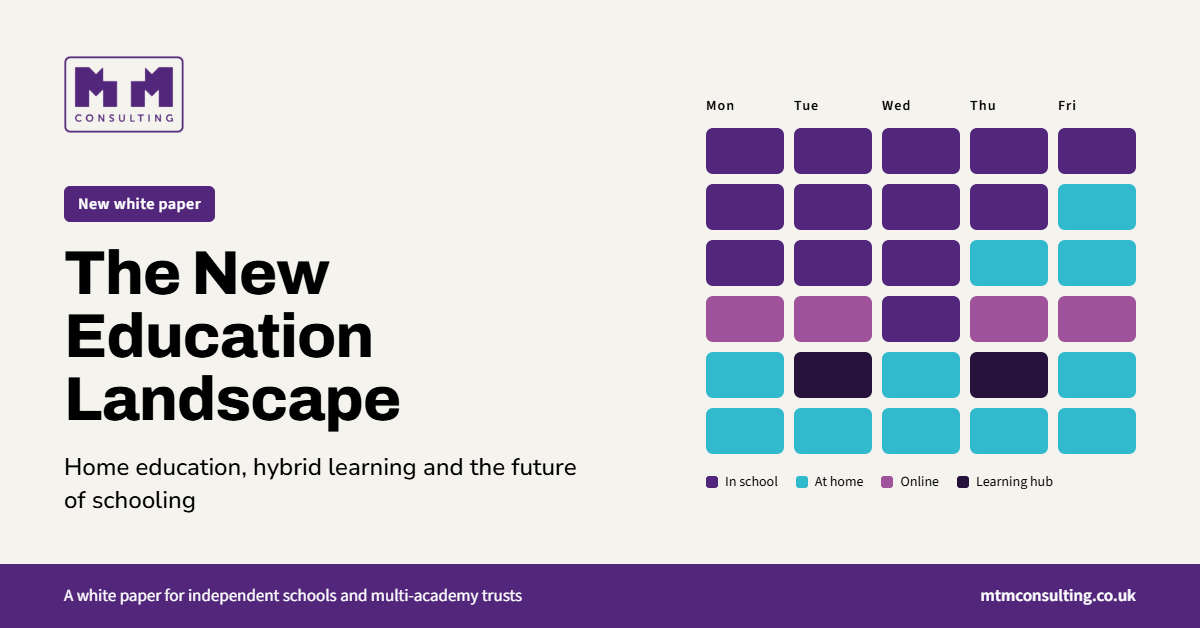
Our new white paper, The New Education Landscape: Home Education, Hybrid Learning and the Future of Schooling, sets out what has changed, why it matters, and what independent schools and multi-academy trusts can do about it.
For generations, the shape of a school education barely moved. Children attended full-time, five days a week, for around 39 weeks of the year. Buildings, curricula and pedagogies differed, but that basic architecture held.
It is holding less well than it used to. On the census date in autumn 2025, at least 126,000 children in England were being electively home educated. That is 1.5% of the school-age population, or roughly one child in every 67. The number has risen every single year since the Department for Education began collecting it nationally.
This isn’t a story about families rejecting education. It’s a story about families rethinking how an education fits around their lives, and increasingly assembling one themselves from tutors, online schools, community groups and occasional in-person provision.
Today we’re publishing The New Education Landscape, a white paper that looks hard at the evidence behind that shift. It’s written for governors, heads, bursars and admissions teams who want to understand what’s happening in their own market, and decide what, if anything, to do about it.
The numbers: steady, sustained growth
The headline trend is clear. DfE’s autumn census put the number of electively home-educated children at 80,900 in 2022. By autumn 2025 it had reached 126,000, an increase of nearly 56% in three years, with growth of 12.8% in the most recent year alone.
Even that figure understates the reach. DfE also counts every child who was home educated at any point during the year, and for 2024/25 that number reached 175,900.
It would be easy to dismiss all this as a pandemic hangover. The evidence doesn’t support that reading. Before DfE’s national census existed, voluntary surveys of local authorities suggested numbers were already rising by around 20% a year in the five years before Covid. The pandemic accelerated a trend that was already under way, and growth has stayed in double figures every year since.
Where it’s happening matters
Growth hasn’t been even. Using local authority data, our analysis found that:
- The North East is growing fastest, with numbers nearly doubling (+98.6%) between 2022/23 and 2025/26, and up 26.6% in the latest year.
- The fastest-moving local authorities cluster in the North East, North West and Yorkshire, led by Middlesbrough (+173%) and Hartlepool (+170%).
- London is growing slowest, and a group of Outer London boroughs, including Barnet, Harrow and Richmond upon Thames, actually saw numbers fall last year.
That pattern is telling. If home education were mainly a lifestyle choice for affluent, mobile families working remotely, you would expect London to lead. It doesn’t. The geography points more towards financial pressure and access to suitable local school places.
Why it matters: two pressures at once
On its own, 126,000 children is 1.5% of the school-age population. The reason it deserves a place on a governing body’s agenda is what it sits alongside.
The pool of children in England is shrinking, for reasons that have nothing to do with home education. DfE’s own projections show the state-funded school population falling from around 7.8 million in 2026 to 7.1 million by 2031, a drop of 9.3% in five years. Fertility fell from 1.9 in 2010 to 1.4 in 2024, well below replacement level.
The independent sector is already feeling it. ISC’s 2025 census recorded 545,640 pupils, down 2.0% on the year before, with new admissions down 5.3%.
Put those trends together and every family assembling an education outside the traditional model is a family that a shrinking market makes harder to replace. For trusts, the link is just as direct: persistent absence, rising SEND need and pupils lost to home education are all part of the same picture.
Hybrid education already exists
One of the paper’s main findings is that schools don’t need to start from a blank page. We map five hybrid models, running from “mostly school” to “mostly home”:
- Traditional school plus one day a week of remote learning
- Part-time attendance, such as three days in school and two at home
- An online curriculum with termly in-person experiences
- Micro-schools sharing facilities
- The school as a learning hub, selling labs, sport, music, languages or exam entry to families who aren’t enrolled full-time
They are not equally established. The first two, known as flexi-schooling, already have a recognised route in England, and in the state sector a flexi-schooled pupil is funded in the same way as a full-time one. The third is mature and well evidenced. The last two are much closer to open ground.
The paper’s case studies show what this looks like in practice:
- Huxley CE Primary School in Cheshire went from just four pupils on roll to 63, with a waiting list, after building a structured flexi-schooling offer. It’s also an honest lesson in what happens when the arrangement is under-resourced, which the paper covers in full.
- King’s InterHigh teaches more than 6,000 students live online, with exam results above the national average.
- Minerva’s Virtual Academy serves more than 900 full-time students, 60% of whom need SEND support.
- Academy21 is commissioned by more than 141 local authorities to support pupils who can’t fully access mainstream school.
- Acton Academy and KaiPod Learning show how micro-school networks and staffed learning spaces are growing internationally.
Opportunities, risks and where to start
For independent schools, the strategic question is whether your addressable market is only families who will buy full-time enrolment. Some families who will never pay full fees might pay for something narrower: three days a week, GCSE or sixth form only, exam entry, or access to a lab, sports hall or music department. No UK independent school has yet done this at scale. That means real first-mover advantage, but also no ready-made playbook.
For multi-academy trusts, the case is arguably stronger, because funding mechanisms already exist. Persistent absence stood at 18.7% in 2024/25, nearly double pre-pandemic levels. The number of pupils with an EHCP who are “educated elsewhere” rose 22.5% in a year to around 50,000. Flexible provision, whether built or commissioned, can help with attendance, retention, EBSA and SEND.
We’re equally clear about the risks. The paper looks at safeguarding, including the national review that led to the Children’s Wellbeing and Schools Act 2026 and its new register of children not in school. It also covers inspection, quality assurance, inconsistent funding treatment, and competition for specialist staff. Most home-educated children are safe and thriving; a small, often hidden minority are not, and schools have a part to play in that.
Read the full white paper
The paper closes with three scenarios for education in 2035: nothing changes, hybrid becomes mainstream, or schools become education ecosystems. It also includes practical questions you should be asking so you can see which of those futures your own school or trust is heading towards, using information you can gather.
That’s the real point. A school that hasn’t looked at its local home education data, its enquiry log or its unused facilities isn’t neutral on this question. It has chosen “nothing changes” by default.
Inside, you’ll find:
- Local authority and regional analysis of home education growth
- Five hybrid models, with what each would take to run
- Seven case studies from the UK and abroad
- Opportunities for independent schools and for MATs
- Targeted questions for governors, heads, bursars and admissions teams
Download The New Education Landscape by completing the form below. If you would like to discuss the options for your school or trust, please contact us via Contact Us.
FAQs
Latest News & Analysis
MTM News
Emily Hargest
|
2nd November 2026
Launching The New Education Landscape
One in 67 children is now home educated. What does that mean for your school? Our new white paper, The New Education Landscape: Home Education, Hybrid Learning and the Future...
Read News Article
MTM Analysis
Emily Hargest
|
28th September 2026
VAT on school fees: What did the House of Lords debate tell school leaders?
On 17 September 2026, the House of Lords returned to one of the most contentious issues facing the independent schools sector: the impact of VAT on school fees. The debate,...
Read Analysis